- Gather Core
- Posts
- Kaulua, Anahulu Hōʻemi
Kaulua, Anahulu Hōʻemi
Limu Series

Cora Johnson
February 18, 2025
Anahulu Hōʻemi
 | Welcome to Gather Core, a newsletter by Onomea Country Market, released at the beginning of each anahulu.
core (n.v.adj.) center, heart, gut, mind, innermost, enduring |
Local Produce
| Baked Goods
| Fridge Items
|
Plant/Animal Feature: Limu
An Introduction to Limu Series: Part 1
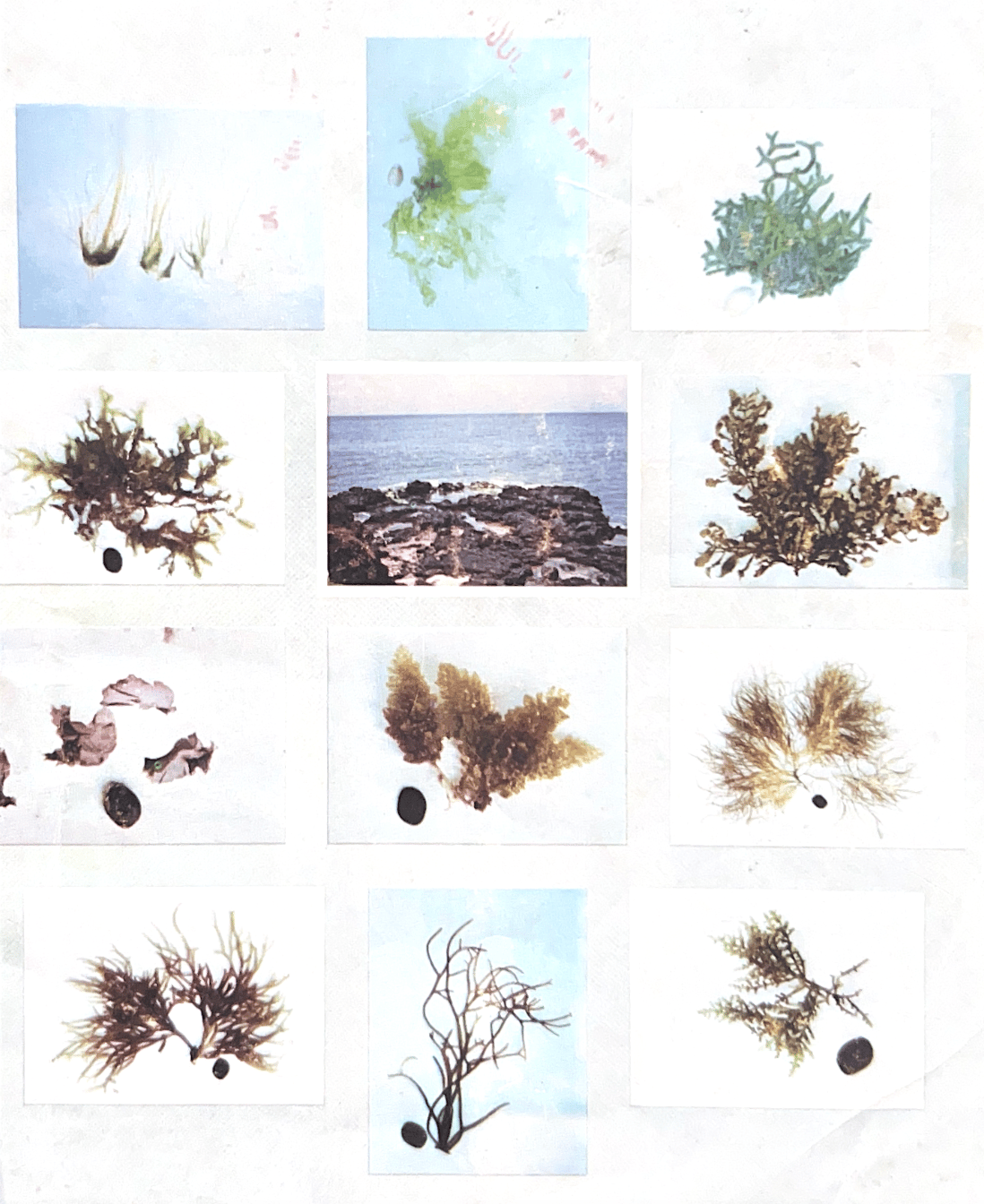
Photos from Limu: An Ethnobotanical Study of Some Edible Hawaiian Seaweeds by Isabella Aiona Abbott and Eleanor Horswill Williamson
There are many ways of seeing, experiencing, and defining Limu. Limu, as defined by Pukui & Elbert (1973), is “a general name for all plants living under water, both fresh and salt, also algae growing in any damp place in the air, as on the ground, on rocks, and on other plants; also mosses, liverworts, lichens.” Freshwater limu is limu wai while salt water limu is limu kai. Limu growing on trees or in the mountains can be called limu lāʻau or limu mauka. In 1984, Isabella Aiona Abbott listed 86 non edible inoa limu and 63 inoa limu referring to edible, marine, freshwater, and brackish water algae.
Limu is used in lāʻau lapaʻau, in ceremony, as a food source, as art material, and inspiration for art. It’s a subject in many moʻolelo. The Kumulipo which can be an oli, mele, moʻolelo, and moʻokūʻauhau tells, as the Earth is filled with water and plants are brought into creation, limu is introduced each with a land plant pairing.
Hanau ka ʻEkaha noho i kai
Kia ʻi ia e ka ʻEkahakaha noho uka
Born the coralline seaweed living in the sea
Kept by the bird’s nest fern living on land
Hanau ka ʻAki ʻAki noho i kai
Kia ʻi ia e ka Manienie-ʻaki ʻaki noho i uka
Born the ʻaki ʻaki seaweed living in the sea
Kept by the manienie shore grass living on land
Hanau ka ʻA ʻala-ʻula noho i kai
Kia ʻi ia e ka ʻala ʻala-wai-nui noho i uka
Born the fragrant red seaweed living in the sea
Kept by the succulent mint living on land
Hanau ka Manauea noho i kai
Kia ʻi is e ka Kalo-manauea noho i uka
Born the manauea noho i uka
Kept by the manauea taro living on land
Hanau ka Ko ʻele ʻele noho i kai
Kia ʻi ia e ka Punapuna, ko ʻele ʻele, noho i uka
Born the ko ʻele ʻele seaweed living in the sea
Kept by the jointed sugar-cane living on land
Hanau ka Kakalamoa noho i kai
Kia ʻi ia e ka Lauaki noho i uka
Born the puaki seaweed living in the sea
Kept by the lauaki sugar-cane living on land
Hanau ka Kakalamoa noho i kai
Kia ʻi ia e ka Moamoa noho i uka
Born the kakalamoa seaweed living in the sea
Kept by the moamoa plant living on land
Hanau ka limu Kele noho i kai
Kia ʻi ia e ka Ekele noho i uka
Born the kele seaweed living in the sea
Kept by the ekele sari living on land
Hanau ka limu Kala noho I kai
Kia ʻi ia e ka ʻAkala noho i uka
Born the kala seaweed living in the sea
Kept by the ʻakala raspberry living on land
Hanau ka Lipu ʻupu ʻu noho i kai
Kia ʻi ia a ka Lipu ʻupu ʻu noho i uka
Born the Lipu ʻupu ʻu seaweed living in the sea
Kept by the Lipu ʻupu ʻu moss living on land
Hanau ka Loloa, noho i kai
Kia ʻi ia e ka Kalama loloa, noho i uka
Born the long seaweed living in the sea
Kept by the tall ebony living on land
Hanau ka Ne, noho i kai
Kia ʻi ia e ka Neneleau noho i uka
Born the ne seaweed living in the sea
Kept by the sumach tree living on land
Hanau ka Huluwaena, noho i kai
Kia ʻi ia e ka Huluhulu-ʻie ʻie noho i kai
Born the hairy seaweed living in the sea
Kept by the hair pandanus vine living on land
*(The following refrain is repeated in between each pairing.)
He po uhe ʻe i ka wawa
He nuku, he wai ka ʻai a ka lāʻau
O ke Akua ke komo, ʻa ʻohe komo kanaka
O kane ia wai ʻololi
O wahine ia wai ʻolaola
It is a night gliding through the passage
Of an opening; a stream of water is the food of plants
It is the god who enters; not as a human does he enter
Male for the narrow water
Female for the broad waters
(from Kumulipo, translations by Beckwith 1972 and Johnson, 1981)
These pairings show the interconnectedness between everything; and specifically between land and sea. They also tell the story of medicinal plant uses as they are used together. In his thesis, Kaleleonalani Napoleon says “The relationship between Hawaiian creation beliefs, Hawaiian cultural practices, and Hawaiian health care practices exemplified by the Kumulipo are significant to the foundations upon which Hawaiian culture survives. The Kumulipo is one of many moʻolelo or paradigms brought to the present. Other creation accounts add to the richness of the folklore, ethnobotany, and logical frameworks of Hawaiʻi.”
Along with being a traditional and cultural food source, limu is important as the base of the food chain. “The broader the base of the food chain is, the more fish we get”, Uncle explains in the video below, Saving Hawaiʻi’s Limu - A Visit With Wally Ito. The fish need to eat the limu too and this continues to have a ripple effect throughout the entire food chain and ecosystem, with potentially devastating results as limu populations decline. Wally says people talk about the loss of fishes but when addressing this, often the focus is on a top down approach when we need to be looking from the bottom up so each trophic level will naturally have more to eat. It’s all interconnected.
Like Uncle Henry Chang Wo from Ewa says in the video below, West Oahu’s Limu - Where did it all go?, development and disruption of stream water flow into the ocean has impacted ecosystem health and thus, health of limu; especially limu that rely on freshwater flowing to the sea. “Whatever happens to the land, affects the ocean…When that mountain water and that ocean water meets, when they hit together, call that the Pō Wai. That’s when the ocean hānau. That’s when the ocean give birth. Our fishes depends on that… they all need that water from the mountain.” Uncle Mike Lee from Nānākuli explains more about how lack of freshwater has an impact, specifically in Waianae; ‘the underground caves that collect water from the mountain in the water cycle brings nutrients to the ocean where regeneration begins for the seaweed, where all the magic takes place.’ Aunty Phyllis Adams expresses the importance of something we can all do to help: keep canals and streams clean of rubbish because it ends up in the ocean. In Nanakuli, at the time of this video, she no longer eats fish or limu from this area because the rubbish coming in from upstream can make it unsafe. “We always try to clean the pāpā… try to keep our area clean for our children, and our grandchildren, and our great grandchildren.”
How do we care for and manage the environment in modern times, when so much is seemingly out of our control? This is on many peoples minds and hearts everyday. The reality is that large entities mismanage and hoard natural resources, foreigners buy land restricting access for kanaka maoli, invasive species run rampant and more are constantly hitching rides in. Recently cuts have been made in federal funding that have impacted so many organizations in the United States, and in Hawaiʻi, that do conservation work. Many people have lost their jobs and predictions being made on how forests, the ocean, native plant and animal populations, and human lives will be impacted, are grim. There’s so much work to be done between cultivating food plants, managing invasive species, planting and caring for native plants, caring for native animals, etc.
How can we contribute? The ways in which we have to work to survive have changed so much in the last hundred years, specifically for kanaka maoli. The current system in place under occupation has created conditions that require these organizations with federal funding to be the lifeline of conservation and farming. I’m not kanaka and don’t ever intend to speak for Hawaiian people. I can say that navigating the modern, capitalistic way of “earning a living” and providing for family with money, under military occupation, in an ever changing environment with a destroyed food system, surrounded by ignorant foreigners - is overwhelming - to say the least. From this large, systemic perspective it can seem out of our control as an individual, but these are conversations we can be having together; how to be in community, to take care of each other, to take care of the land and ocean in whatever way is available to us. We all have a role. How can we open up these conversations? What can we do to make action in our lives? How can non kanaka change the way we live individually and collectively to shift the way things are for kanaka in their ancestral homeland?
I don’t have The Solution but, it’s an ongoing and lifestyle based effort. If even a few people feel connected to experiences/thoughts I share; or watches these videos or reads the books listed below, of kūpuna and kanaka sharing their ʻike, then I hope that plays a small role in the web of a changing world. I have access to information and resources worth sharing and all of the credit goes to them. I like compiling and finding connections between it all.
By putting this out into the digital world I know I open myself up to ~all kinds of conversation, and I welcome it online and in person. If you’d like to reach out my email is [email protected]. I’m also happy to try to help share where you can find any of the books I reference.
Uncle Wally Ito briefly discusses community-based subsistence fishing practices which we’ll look at more, along with sustainable harvesting in modern times and limu as a food source including recipes. Below is an incredible video with Isabella Aiona Abbott, who did so much research and writing on limu, their stories. The practice of listening to kūpuna is beyond healing and can be a guiding star in uncertain times.
SOURCES
He Kālailina I ka Limu ma ka Lāàu Lapāau: He nīnauele me hulu kupuna Henry Allen Auwae. An Analysis of Limu Used in Hawaiian Medicine: An Interview with Esteemed Elder Henry Allen Auwae. By Kaleleonalani Napoleon
Limu: An Ethnobotanical Study of Some Edible Hawaiian Seaweeds by Isabella Aiona Abbott and Eleanor Horswill Williamson
The Kumulipo: A Hawaiian Creation Chant translated by Martha Warren Beckwith
Kumulipo, the Hawaiian Hymn of Creation Vol. 1 by Rubellite Kawena Johnson
Hawaiian Reef Plants by John M Huisman, Isabella A. Abbott, and Celia M. Smith
Maker Spotlight: Māmaki Skin
Māmaki Skin is a farmer/therapist-run company dedicated to sharing the therapeutic properties of māmaki through their beyond-organic skincare line.
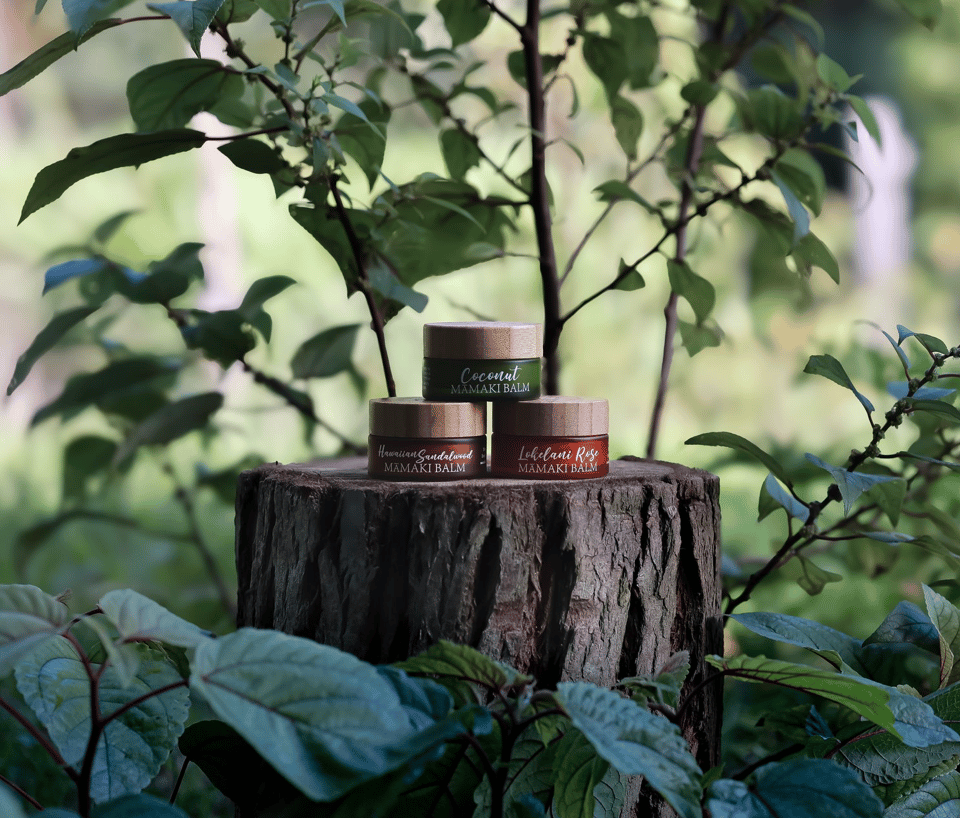
From Māmaki Balms for head-to-toe rejuvenation to the Lavalava Mask for deep rehydration, their products are made with naturally grown plants from their farm on Hawaiʻi Island, where they make their own extracts.
They partner with other local organic farms and source every ingredient based on stringent criteria to make sure there are no harmful chemicals, pesticide residue and other toxins in the products. They complement their skincare line with a flavorful māmaki tea collection so you can also combat skin issues from the inside out.
Their ʻāina-based initiatives include their upcoming Invasive Medicinals line: instead of merely killing off invasive species by using poisons and/or creating waste, they turn them into extracts that bring healing. Whenever they chop down an invasive species, they replant the area with native Hawaiian plants.
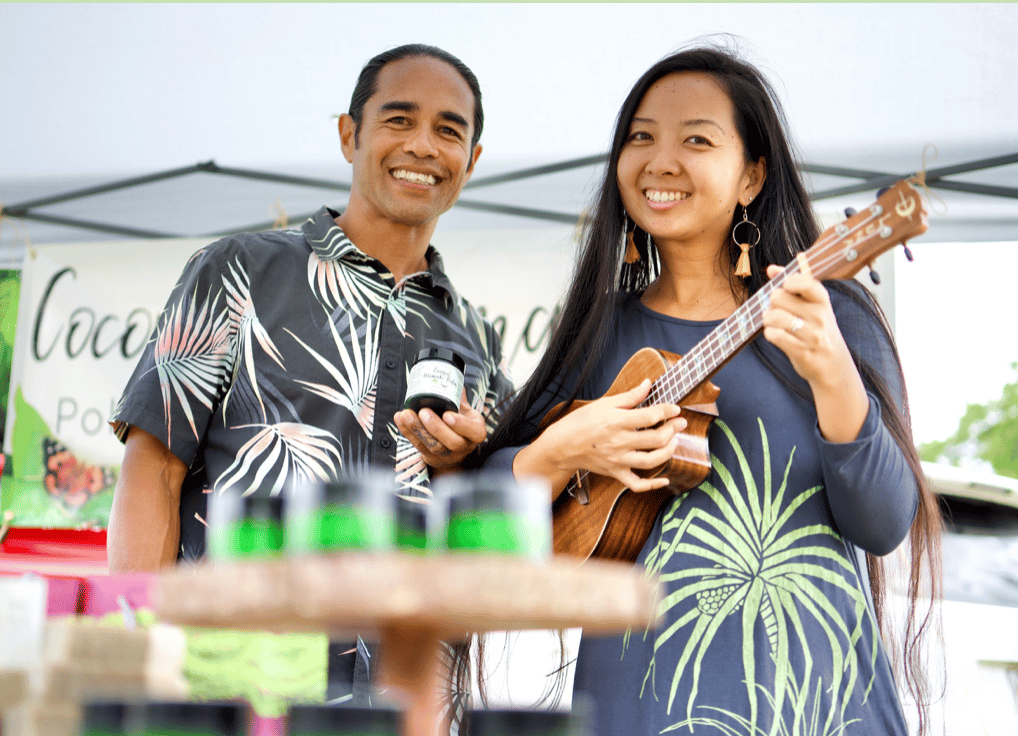
Owners Doug and Mayu say that listening to nature is how they make all of their decisions. “We didn’t set out to make a skincare brand because we wanted to make money off of commodifying nature, or simply to help people look good. We want the world to have people who are healthy and are truly one with nature.”
As a chart-ranking musician-turned certified therapist, Mayu started making balms and other natural products in 2006, mainly to just share with family and clients. Fast forward to 2022, Doug was the one who suggested they add māmaki to the balms. Māmaki had already been popularized as a tea, but nobody had featured it in skincare. They walked into almost all of the shops on Kauaʻi, making friends with other small business owners along the way, and within 2 months, their Coconut Māmaki Balm was sold at 40 locations across the islands.
“In ʻŌlelo Hawaiʻi, the word ʻnature' doesn't exist, because we are not separate from it. It's the same in Samoan, in CHamoru. It’s the same in Japanese, too. (Doug is Samoan-Chamorro and Mayu is Japanese) Shizen is the Japanese word for nature, but it did not come into existence until the 19th century when a translation was needed for the English word. In indigenous cultures, there was no separation between us and nature.
We ARE nature, and if each one of us can remember that, we would first do no harm, and we would do what is truly right, based on nature’s principles. That is how we farm, how we make our products, and how we try to live our life in general.”
You can find Māmaki Skin products at Onomea Country Market. Online, you can connect with them on their website at https://mamakiskin.com or on their IG @mamakiskin.
 |  |
Song of the Anahulu
New song release by Spock, Pili Boyo, and Māwae
Community Happenings
The Lei Bar - Lei Poʻo Workshop February 9th, 23rd, & 28th , 2025
theleibar.com and @theleibar on Instagram.
The Lei Bar - Regular Business Hours:
Sun & Mon 8AM-5PM
Thurs & Fri 8AM-6PM
Onomea Farm Hub is offering 2 internship positions through the Kapili Oihana program. Find more information at instagram.com/onomeahub and in the photos below. Interested candidates can apply at linktr.ee/onomeahub
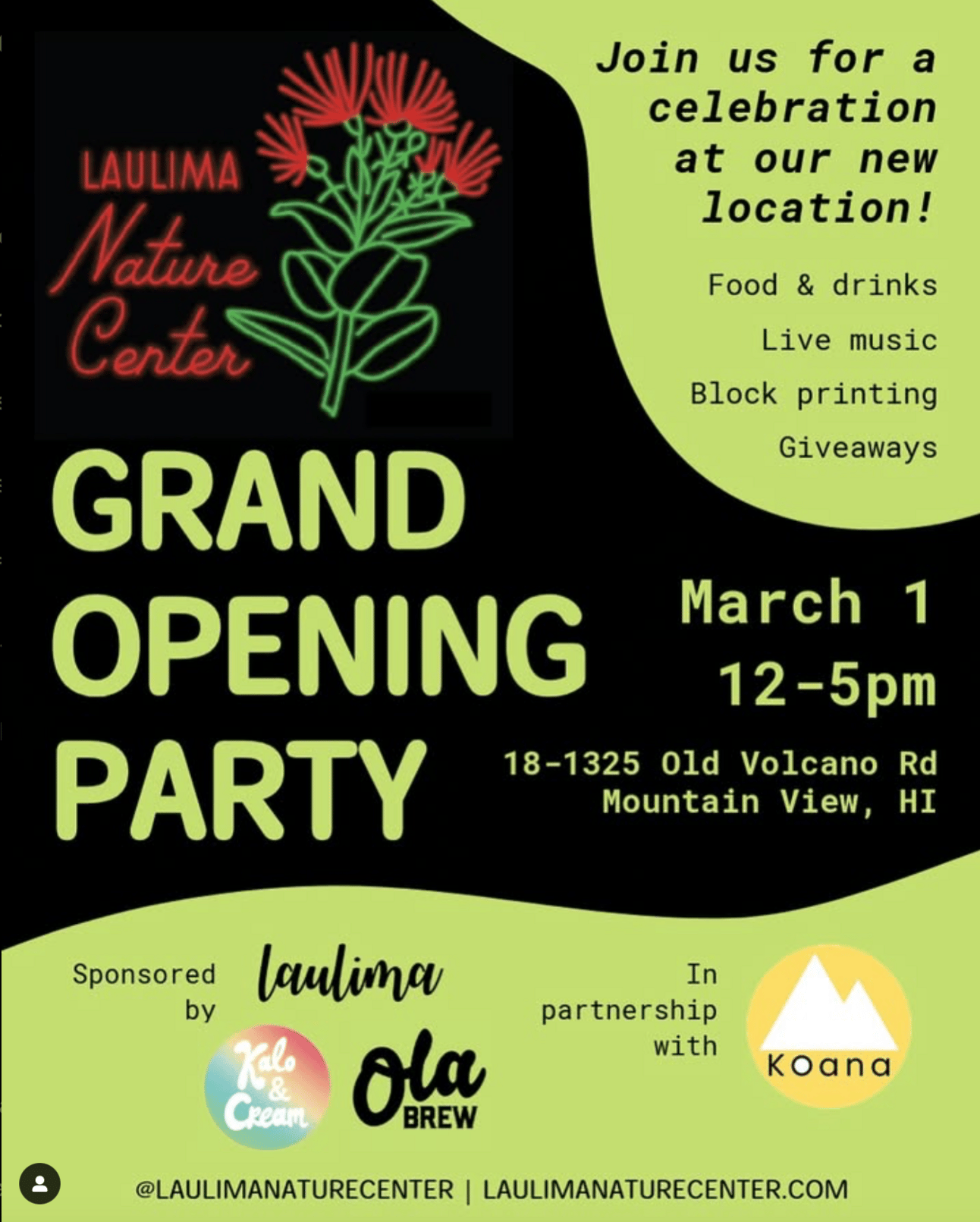
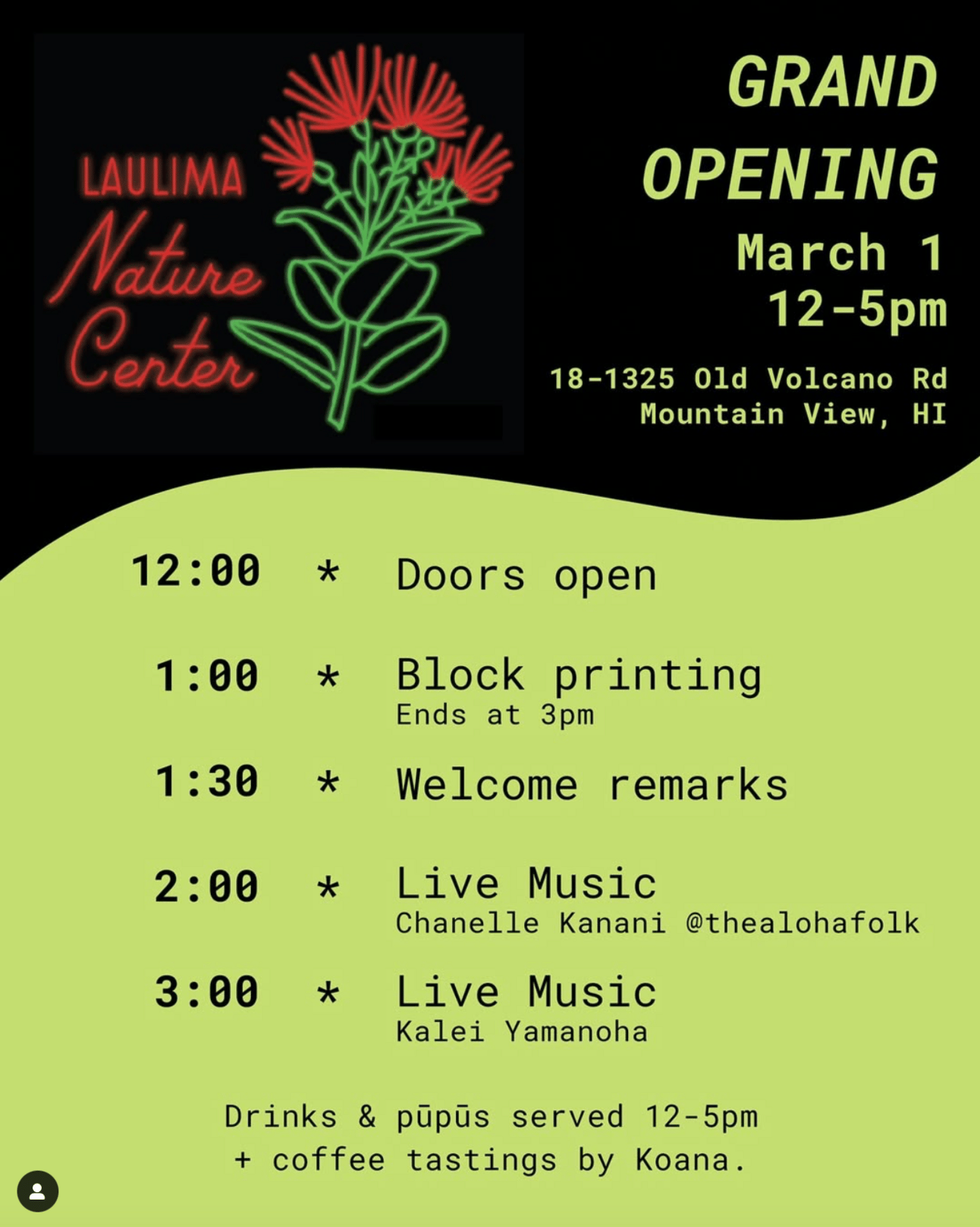
Laulima Nature Center Grand Opening Party. Saturday, March 1st 12pm-5pm. Join them for a celebration at their new location! 18-1325 Old Volcano Rd, Mountain View, HI. Food & drinks, live music, block printing, giveaways. Find them at @laulimanaturecenter on Instagram and laulimanaturecenter.com
Hale O Lono Workday every 2nd Saturday of the month. Plan for next month! 9am-11:30am. Join them in connecting with ʻāina through traditional Hawaiian fishpond management in Keaukaha. More information at @hale_o_lono on Instagram and edithkanakaolefoundation.org/sites Potluck encouraged. Recommended to bring tabis, gloves, sunscreen, and water.
 |  |
 |  |